

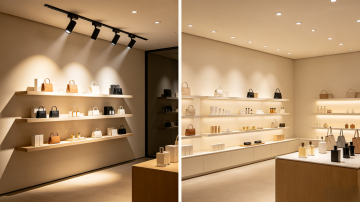
 Choosing between track‑mounted and recessed LED spotlights is one of the most impactful lighting decisions in retail design.
The choice influences visual merchandising flexibility, ceiling aesthetics, installation cost, maintenance, and long‑term operating efficiency.
This guide explains the differences, trade‑offs, and best‑fit scenarios so you can specify LED retail spotlights with confidence.
Track‑mounted LED spotlights are adjustable fixtures that attach to a powered track. They are popular in retail because they offer:
High flexibility: Easily re‑aim, add, or remove heads to match new displays
Fast merchandising updates: Ideal for seasonal layouts and frequent product rotations
Directional precision: Adjustable pan/tilt for targeted accent lighting
Accessory options: Snoots, honeycomb louvres, and barn doors for glare control
Control ready: Single/dual/3‑circuit, DALI track, or wireless control adapters
Best for:
Fashion and specialty retail with frequent changeovers
Window displays that need punchy accent light
Pop‑up shops, modular shop‑in‑shop concepts
Stores where ceiling is concrete (no cavity) and surface mounting is preferred
Trade‑offs:
Exposed hardware (tracks and heads) affects minimalist aesthetics
Requires tidy cable/track planning to avoid visual clutter
Slightly more dust exposure on visible fixtures in high‑traffic stores
Recessed LED spotlights sit within the ceiling, exposing only a trim or small aperture. They are chosen for:
Clean ceiling plane: Minimal visual clutter and premium architectural finish
Enhanced customer focus: Light appears to “come from the architecture,” not the hardware
Excellent glare control: Deep regress, baffles, and louvres reduce direct view of the LED
Stable layouts: Consistent, repeatable aiming for long‑term merchandising
Best for:
Luxury retail, cosmetics, jewelry, automotive showrooms
Stores with a strong architectural identity and fixed display zones
Projects seeking low Unified Glare Rating (UGR) for comfort
Trade‑offs:
Lower reconfiguration flexibility vs. track heads
Requires ceiling cavity and coordinated cutouts
Relocation involves more construction work than moving a track head
Ceiling type
No cavity / exposed concrete → Track‑mounted LED spotlights are often the practical choice
Suspended or drywall ceilings with plenum space → Recessed LED spotlights are feasible
Ceiling height
<3 m: Recessed or compact track heads with medium beams (24–36°) work well
3–6 m: Higher output heads with narrower beams (12–24°) to maintain contrast
6 m: Consider high‑output spot modules and precise optics; track offers easier re‑aiming
Store layout dynamics
Frequent display rotations → Track gives faster adaptation
Stable, high‑end displays → Recessed supports a refined, consistent look
Track‑mounted LED spotlights
Rapid re‑aiming and repositioning without ceiling work
Add/remove fixtures along the track as needed
Ideal for campaigns, new arrivals, and window storytelling
Recessed LED spotlights
Depend on pre‑planned grid and aiming angles
Gimbal/adjustable trims offer some flexibility but within fixed cutouts
Perfect for consistent brand lighting where zones rarely move
If weekly visual updates are your norm, track systems typically win.
Beam angles
Narrow (10–20°): Punchy accents for hero items and window displays
Medium (24–36°): General accenting across shelves and racks
Wide (40–60°): Ambient fills or soft washes
Color temperature (CCT)
3000K: Warm, premium brand feel (luxury fashion, jewelry)
3500–4000K: Balanced modern look for most retail categories
5000K: Very crisp for tech or sports concepts
Color rendering (CRI)
CRI 90+ recommended for apparel, cosmetics, leather goods, and food
Consistency across fixtures (same CCT/CRI bin) avoids patchy color impressions
Both track and recessed LED spotlights can deliver high CRI and tailored optics; your choice hinges more on ceiling and flexibility than on achievable light quality.
Recessed spotlights
Deep regress, matte black baffles, and small apertures reduce direct source visibility
Often achieve superior UGR and a premium, comfortable ambience
Track spotlights
Use accessories (snoots, honeycomb, barn doors) to cut glare
Choose micro‑prismatic lenses or soft‑edge optics for customer comfort
In high‑end boutiques where comfort is paramount, recessed typically has the edge; track can match with the right accessories and aiming discipline.
Controls
Track systems: 1/2/3‑circuit, DALI track, wireless nodes for scene setting by zone
Recessed systems: DALI/0–10V/Triac drivers integrated per fixture or in groups
Energy
Both use efficient LED modules; energy differences come from optics and dimming strategies
Layered scenes (accent + ambient) reduce overall wattage while enhancing contrast
Maintenance
Track: Easy access to heads for cleaning or replacement; fast re‑aiming
Recessed: Cleaner look, less dust on hardware; driver access must be planned (remote vs integral)
For multi‑site chains, consider how store teams will re‑aim or service fixtures with minimal disruption.
Track‑mounted spotlights
Visual clutter from poorly planned track routes
Uncontrolled glare from bare lenses at low heights
Over‑accenting that creates harsh contrast and customer fatigue
Recessed spotlights
Fixed cutouts misaligned with future display changes
Shallow regress causing glare in glossy environments
Insufficient output at higher ceilings leading to flat visuals
Mitigate risks with mock‑ups and a lighting layout tied to the merchandising plan.
Luxury fashion / cosmetics (stable layouts, premium ambience) → Recessed LED spotlights with deep‑regress anti‑glare; CRI 90+, 3000–3500K
Fast fashion / lifestyle (frequent refresh, wide assortments) → Track‑mounted LED spotlights for rapid re‑aiming; mix of 24–36° beams
Window displays / pop‑ups (high impact, seasonal) → Track systems with narrow beams and high‑output heads; accessories for glare control
Supermarkets / big box (hybrid needs) → Recessed for general zones + track accents over promotional bays or gondola ends
Jewelry / fine goods (sparkle, precision) → Recessed with narrow beams and excellent glare control; consider 3000K with high CRI/R9
Ceiling conditions: cavity available (recessed) or solid slab (track)?
Merchandising dynamics: frequent re‑aiming (track) or stable zones (recessed)?
Aesthetic intent: minimal ceiling (recessed) or expressive, flexible hardware (track)?
Glare control: deep regress (recessed) vs accessories (track)
Beam plan: narrow for hero items, medium for general accents, wide for fills
CCT/CRI: align with brand mood; CRI 90+ for fashion/cosmetics/jewelry
Controls: DALI/0–10V/wireless scenes by zone and time of day
Maintenance: access strategy for drivers and heads across all stores
There’s no one‑size‑fits‑all answer. Many top retail environments combine both: recessed LED spotlights for a clean, luxurious baseline and track‑mounted LED spotlights for agile merchandising and windows. Start with the brand story and merchandising plan, verify on a small mock‑up, then scale with standardized SKUs for consistency across locations.